Detection tells you something looks wrong.
Understanding tells you what students actually know.
AI made it impossible to tell authorship from a submission alone. Tomax shifts the question from who wrote this to whether the student can explain it, and gives faculty the evidence to stand behind every grade.
Trusted by 150+ institutions · 500K+ exams a year · 20+ countries
 Oral defenseFinal assignment: Equations and motion problems
When solving an equation with fractions, such as 2/3 − x/15 = 2 − x/5, briefly explain how you get rid of the denominators, why that’s allowed, and how you check the solution is correct.
To get rid of the denominators I multiply both sides by 15, the common multiple. Doing the same to both sides keeps the equation balanced. Then I solve and get x equals 10, and check by substituting it back: both sides come to zero.

My draft Private
Multiply both sides by 15, then check by substituting back.
Question 1 evaluation Sample report
Reviewed by the instructorNames the step and the goal.
Says both sides change equally.
Shows the resulting equation.
The Shift
Why detection alone stopped working
Generative AI removed the signal that plagiarism tools were built to read. Institutions are left with accusations they can’t prove and students they can’t fairly assess.
Similarity scores lost their meaning
AI-written work is original by every measure a text-matching tool can apply. A clean report no longer says the student did the work.
Faculty carry the burden of proof
Suspicion without evidence puts lecturers in an impossible position, and puts honest students under a cloud they cannot clear.
Credentials are what is actually at risk
A degree is a claim about what a graduate can do. When that claim goes unverified, the institution's reputation absorbs the cost.
Two Ways In
Secure the exam. Verify the understanding.
Most institutions start with one and add the other. Both run inside the same platform, on the same audit trail.
Online Exam Proctoring
Controls the conditions, layer by layer. Mobile proctoring, 360° room verification, live invigilation, and AI-driven monitoring work alongside screen and camera recording, remote-software and VM detection, and cross-platform lockdown, so the exam environment stays sound from first login to submission.
Smart Defense
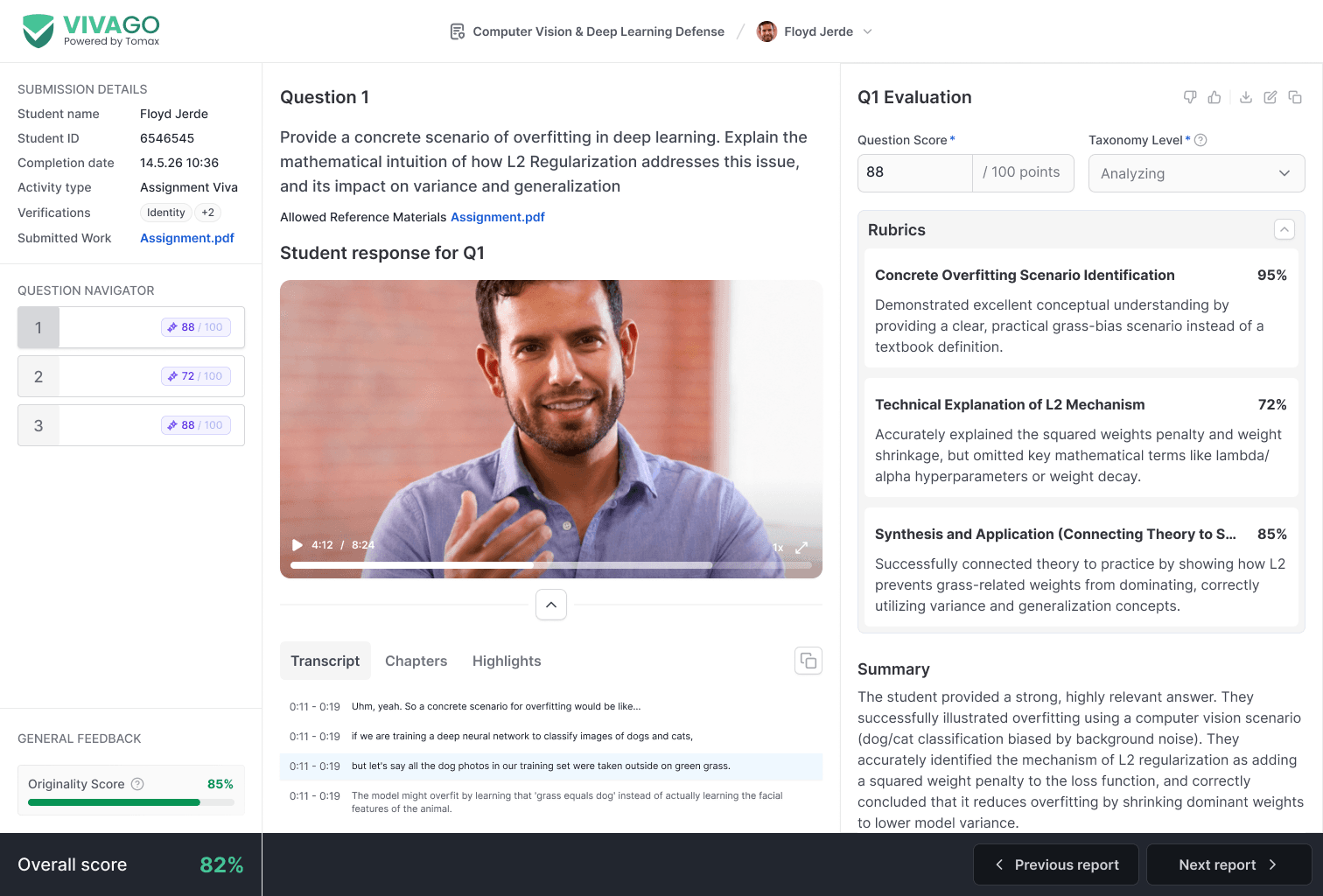
Verifies the person. Students explain their reasoning in their own words, and faculty see whether the understanding behind the submission is real, on coursework as well as exams.
How It Works
Three steps, no new grading pass
Lecturer adds Smart Defense
Enable a defense step on any assignment or exam. No change to how the assessment is written or delivered.
Student records defense response
The student answers short questions on video, explaining their reasoning in their own words.
Lecturer checks understanding
Responses arrive alongside the submission, so faculty confirm genuine understanding and reply with targeted feedback, without extra grading passes.
What’s inside the integrity stack
Every capability is part of the same assessment platform, so integrity data sits next to the submission it belongs to.
Identity verification
Confirm the person sitting the exam is the enrolled student, before the first question loads.
Secure exam environment
Lockdown browser and controlled device conditions on both Mac and Windows, for online high-stakes exams.
Live monitoring
The Monitor control room surfaces anomalies in real time, so invigilators intervene during the exam rather than weeks later.
Smart Defense
Students explain their reasoning in their own words, on coursework as well as exams.
Question scrambling
Randomised versions across online and printed exams, so no two students see the same paper.
Full audit trail
Every action timestamped and retained, exportable for academic misconduct proceedings.
Screen & camera recording
Every screen and camera feed is recorded for the duration of the sitting, reviewable alongside the submission.
AI & remote software detection
Flags AI writing tools, remote-access software, and other unauthorized processes running during the exam.
Virtual machine blocking
Detects and blocks sittings launched inside a virtual machine, closing a common bypass for lockdown controls.
Evidence, Not Accusation
A record that holds up in an academic hearing
Integrity cases fail when the evidence is a probability score. Tomax produces a timestamped record of what the student did and said, tied to a verified identity, that faculty and committees can review directly.
- Verified identity linked to every submission and defense response
- Timestamped session log covering the full exam, not sampled moments
- Student's own explanation in their own voice, reviewable by the committee
- Exportable case file that meets institutional retention policy
“With Tomax VIX we slashed costs, scaled assessments to 32 countries, and deliver results faster – all while meeting every compliance bar.”
Amy Simrah Chadney
Deputy Head of Registry Services, Arden University
Common questions
No. Proctoring secures the conditions of an exam; Smart Defense verifies the understanding behind the work. Institutions use them together, or start with one and add the other. Smart Defense also extends to coursework and take-home assignments, where proctoring does not apply.
Smart Defense is a pedagogical step, not a surveillance one. Students explain their reasoning, which is a normal part of learning, and the response becomes an opportunity for faculty to give targeted feedback. Honest students gain a way to demonstrate what they know.
Defense responses arrive alongside the submission in the same grading view, so there is no second grading pass. Lecturers enable the step when creating the assessment and review responses where they matter.
Tomax is GDPR compliant and supports regional data residency. Integrity data is retained according to your institution's policy, is accessible only to authorised staff, and is exportable or deletable on request.
Ready to see Tomax in action?
Secure, credible assessment: online and on paper, in one platform.
Request a Demo